Come Together: How the Beatles reunited to make new music in the ‘90s Part 3
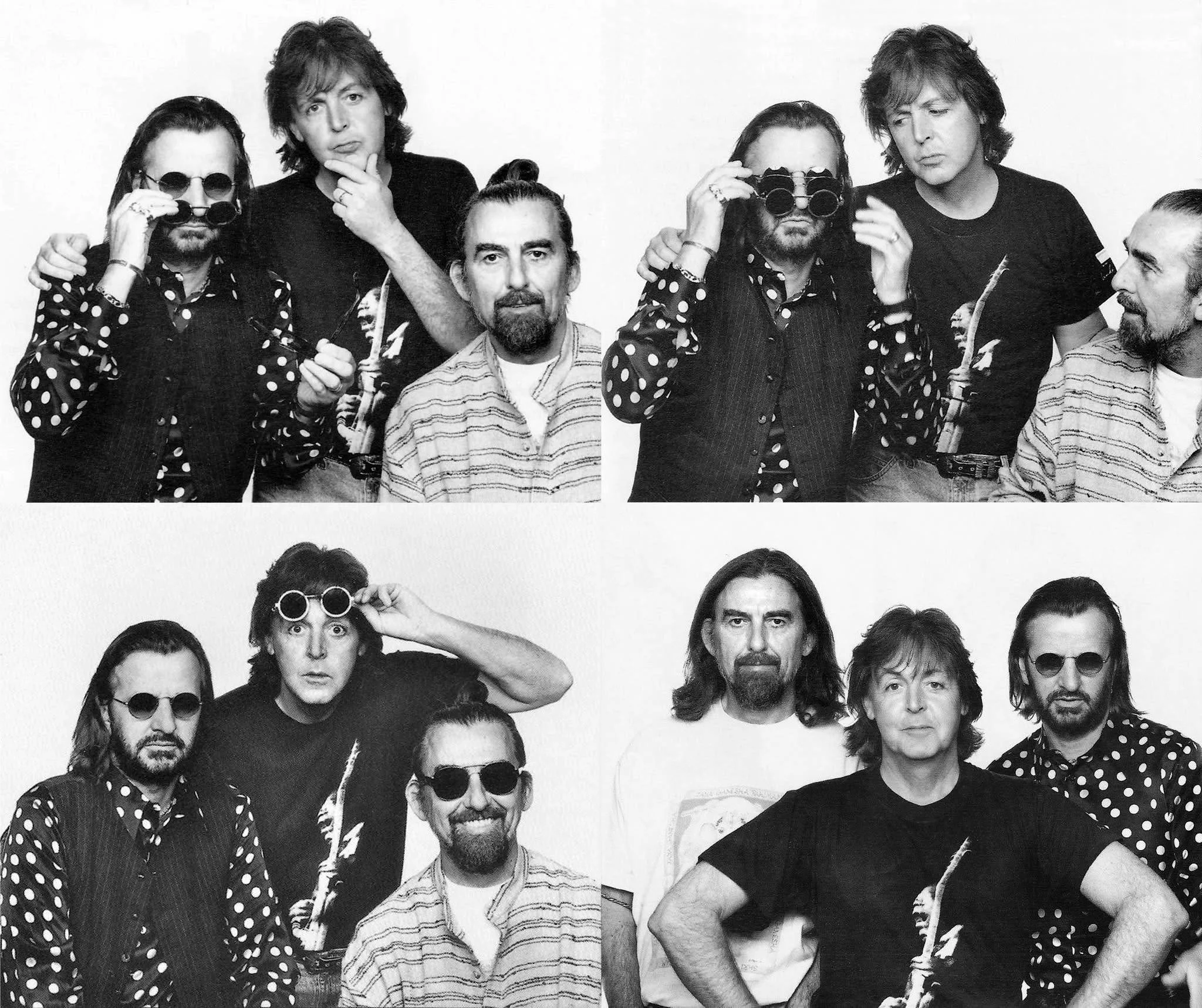
© 1995 PAUL MCCARTNEY. PHOTOGRAPHER: LINDA MCCARTNEY
Thirty years after the Beatles Anthology, it seems pre-ordained that Paul McCartney, George Harrison, and Ringo Starr would reunite to create new music together. However, up until the very moment the trio entered the studio in 1994, it was not clear if they would make music at all or if their efforts would even see the light of day.
In Part 1, we looked at how the decision came about to make new music. In Part 2, we focused on how ‘Free As A Bird’ came to be. Here, in the third and final part of this series, we look at the second ‘90s reunion song, ‘Real Love,’ as well as the consideration of the song ‘Now And Then.’
A second song
After finishing ‘Free As A Bird,’ the following year, in 1995, McCartney, Harrison, and Starr reconvened to work on a second song. McCartney was originally supposed to attend the launch of a talent drive for the Liverpool Institute for the Performing Arts but begged out with a news-breaking statement.
“I'm sorry I can't be there with you but I've got the best possible excuse – I'm working in the studio on a couple of tracks from a '60s beat group you may have heard of, the Beatles,” McCartney said. “These tracks will be released at the end of this year as a couple of cherries on the cake of the Beatles Anthology.”[43]
Contrary to popular belief, when the group went to work on a second song, the initial intent was to work on the song that ultimately became ‘Now And Then,’ released in 2023. (Initially, the song was untitled and referred to as either ‘Now And Then’ or ‘Miss You.’) However, there were multiple issues with the song.
“We had a go at it, but there were a lot of words that hadn’t been completed on it,” Lynn said. “‘Real Love’ was actually a complete, finished song, so we decided then we’d go for that one because of the time frame.”[11]
“F-cking rubbish”
This does not seem to be a fully accurate reason the group turned away from ‘Now And Then.’ In McCartney’s telling, they had chosen ‘Free As A Bird’ in part for the very reason that it required input. Somehow ‘Now And Then’ was different.
“There was only one of us who didn't want to do it,” McCartney admitted. “It would have meant a lot of hard work. The song would have needed a lot of re-writing, and people would have had to be very patient with us.”[44]
McCartney continued, “We all decided that it’s not one of John’s greatest songs. So that we’d have to manipulate all of that, which is just a little bit more difficult.”[16]
Much later on, McCartney revealed that Harrison was sour on the song. “We started working on, but George went off it,” McCartney said. “‘Fucking rubbish this is.’ ‘No George, this is John.’ ‘It’s still fucking rubbish.’”[45]
There was, however, as Lynne mentioned, time pressure as well. Starr had a commitment to tour that summer with his All-Star Band.
“I told the boys, this year, this is it for me,” Starr said after the group completed ‘Real Love.’ “I'm doing the tour. I’m going out.”[9]
Making ‘Real Love’
Instead, the group turned their attention to ‘Real Love.’ Initially, they had passed on the song due to due to technical challenges.
“There was a buzz that went through it, an electronic buzz goes right through the tape if you listen to it,” McCartney said. “I hadn’t really noticed it because I don’t listen to things like that. But Sean [Lennon] actually pointed it out to me when he was playing it to me. He said, ‘What are you going to about the buzz, man? You know there’s a big buzz there.’”[16]
The problem wasn’t just the buzz. It was significantly worse.
“The problem I had with 'Real Love' was that not only was there a 60 cycles mains hum going on, there was also a terrible amount of hiss, because it had been recorded at a low level,” said producer Jeff Lynne.[31]
The tape was also not in the best condition either. It was a copy of a copy.
“I don't know how many generations down this copy was, but it sounded like at least a couple,” Lynne said. “So I had to get rid of the hiss and the mains hum, and then there were clicks all the way through it. When we saw the graph of it on the computer, there were all these spikes happening at random intervals throughout the whole song. There must have been about 100 of them. We'd spend a day on it, then listen back and still find loads more things wrong.”[31]
Harrison described the issues with ‘Real Love’ similarly, though adding additional layers. “The problem was that it was this bad copy, and it had this tambourine that was out of time and real loud,” Harrison said. “That was the only reason we passed on [‘Real Love’] originally.”[37]
Lynne spent time trying to reduce the noise. "It was very difficult, and one of the hardest jobs I've ever had to do, because of the nature of the source material; it was very primitive sounding, to say the least,” Lynne said.[31]
More problems appear
‘Real Love’ also had an issue with the tape speed.
“The problem is that no two cassette recorders on earth run at the same speed,” explained Marc Mann, who worked with Lynne on cleaning up ‘Now And Then’ and ‘Real Love.’ “So the one John recorded his original song on was running at a slightly – very slightly – different speed than the one we were using.”[46]
To accommodate for this, Mann and Lynne moved the song up a half tone. This makes Lennon’s voice sound slightly faster.
“There's an unusual thing that the ear can tell," said Mann. "Even if we had adjusted the pitch digitally in the computer, which would have enabled us to keep the tempo the same as he had recorded it, the listener would detect a change in the timbre of John's voice that would appear as 'sounding slow.’”[46]
After the buzz, click, and tape speed issues were resolved, there was still the issue of timing. As with ‘Free As A Bird,’ Lennon sped up at times and slowed down at others.
“Having done ‘Free As A Bird,’ we knew we couldn't just put the cassette on a 24-track and overdub on that, because the tempo never holds up,” Harrison said. “So again, we did the same thing we'd learned from ‘Free As A Bird’: we put down a drum at an average speed, because it picks up and slows down a bit here and there. We laid the track down and then ‘flew’ John's voice; once we'd built the track up with drums, bass, guitars, and pianos, we just dropped John's voice into the appropriate places.”[37]
Mann used the tools at his disposal to address other aspects of the song. “'Real Love' had an intro that wasn't exactly solid,” Mann said. “When the intro repeated after the first chorus leading into the second verse, it was better that time around. So we copied that one and moved it up to the front.”[47]
Prior to handing the tapes over to be worked on, Mann also came up with a suggested ending for the song. He repeated the chorus.
“'Real Love' didn't have an ending, so I had this idea of, what if we ended on the chorus?” Mann said. “Jeff said, 'Okay, just do it.’ So what I did was I took every alternate phrase of John singing 'real love' and made a repeating fade-out chorus."[47]
Instrumentation
Initially for ‘Real Love,’ the group had started with Lennon singing, a piano, and a tambourine. In the end, almost everything on the song except for Lennon’s vocals was added in the ‘90s.
“Everything that's on ‘Real Love’ is new, except for John's voice and the little intro section that it comes back to, where there's a pedal harmonium and some old wobbly piano that sounds like it's from the distant past,” Harrison said. “That was John's original piano and things, but we actually double-tracked it, just to give it a bit more weight.”[37]
For the song, Harrison used a guitar given to him by Bernie Harmburger. “It's a solid-body electric guitar that's painted green, and that's what I play the solos and all the little fills on,” Harrison said. “…But then, there's also the slide guitar, which comes in at the end, which is a Strat.”[37]
McCartney used a double bass originally owned by Elvis Presley’s bassist Bill Black. “On 'Real Love' he used his double bass, and we tracked it with a Fender Jazz,” Lynne said.[31]
McCartney said that there were some special moments during the recording. “There was one real nice moment when we were doing ‘Real Love’ and I was trying to learn the piano bit, and Ringo sat down on the drums jamming along. It was like none of us had ever been away.”[7]
Doing the impossible…again
Overall, the Threetles successfully pulled off a second song. Still, it appears to have felt somewhat less satisfying to have done the impossible twice.
“It was more difficult actually because we’d already done it. So now we’re doing it again,” Starr said. “…For me I felt it was more difficult to turn [‘Real Love’] into a real Beatle track.”[21]
As noted, ‘Real Love’ was also a fully finished song. It didn’t require the input that ‘Free As A Bird’ did, which made it less fulfilling.
“So we couldn’t really get any words,” McCartney said.[21] “It was fun doing it…We were more like ‘sidemen’ to John, which was joyful, and I think we did a good job.”[36]
However, McCartney did get to sing alongside Lennon on the song. Lennon’s vocal needed some support.
“I actually did another old Beatle trick of singing along with him,” McCartney said. “In things like ‘I Want to Hold Your Hand,’ (sings) it would be me and John singing in unison rather than harmony. So we did that on this one to bolster the quality of his voice. I kind of did a bit of a John Lennon impression. ‘Cause if I sang along with it, it didn’t sound too good because my voice is much rounder than John’s.”[21]
Expecting criticism
While using Lennon’s home demos solved the issue of making true Beatles songs, it created other potential issues. McCartney, Harrison, and Starr knew there would be criticism of both using Lennon’s demos and of reuniting to create new music. McCartney, however, would have none of it.
“My answer to that is, look, do you think we’re stupid enough not to have checked all these angles out, that you, as some casual pundit, throw out?’” McCartney said. “'You don’t think that we, as the professionals who are engaged in this, check that out a hundred times more than you ever would? Because we did, we checked it out amongst ourselves, we made sure that we were happy to do it. We checked it out with Yoko, or else we couldn’t have had the cassette. We checked it out with Sean, who said, ‘It’s going to be a little spooky hearing a dead guy on lead vocal’ and I said to him, ‘So you mean we shouldn’t do it?’ and he said, ‘No, no, you should try it.’ We checked it out on every conceivable level.”[34]
If anything, McCartney said that the criticism inspired the group.
“The point is, we were working with John,” McCartney said. “That was the fantastic thing. We got the attitude right. We weren't worrying about what the pundits said. It was like, fuck them. Really fuck them. It helped us to focus, someone saying: You won't be able to do this, so fuck you...? We fucking will, now you've said that. It got our hackles up.”[7]
Still, McCartney did have some sympathy for the criticism. He remembered a similar feeling when he was younger.
"When we were kids, when Buddy [Holly] died, they did some records with a group called the Fireballs instead of the Crickets, and they put Buddy's voice on it, and we always thought that was terrible…But they weren't his group, so I kind of rationalize it, thinking, you know, if it had been the Crickets, I might have thought it was OK."[48]
Had McCartney, Harrison, and Starr reunited and made new music themselves, the criticism would have been that it wasn’t really a Beatles record. Using Lennon’s demos helped protect, somewhat, against that.
“This way we can say, 'Look, it is the Beatles, whether you like it or not, even if it is done technically, it actually is the Beatles on the record – through the wonders of technology,” McCartney said.[38]
What would Lennon have thought of it all? Of course, no one can fully know. McCartney, however, felt that he had a pretty good idea.
“I must be one of the people who knew John the best out of his life, and I must be in the top three,” McCartney said. “And I knew how he liked to work. I knew what excited him. I knew what excited him about music, certainly for the period I worked with him, and he would have been dead chuffed with this. I mean, I know he would, it would...I'll tell you he would have loved 'Free As A Bird.’”[49]
Harrison agreed.
“I think he would like it,” Harrison said of Lennon. “In fact, I said to them ‘I hope someone does this to all my crap demos when I’m dead. Make them into hit songs.’”[8]
And in the end
Overall, the reunion songs had been a long time in the making. In the end, McCartney Harrison, and Starr were all pleased with how the new songs turned out.
"I'm proud of the two new songs,” McCartney said. “’Free As A Bird’ is really emotional. I've played it to a few people who've cried, because it's a good piece of music and because John's dead. The combination of that can be emotional. But I love that. I don't have a problem with something that grabs you by the balls so you've gotta cry. I rather respect that."[7]
Harrison, meanwhile, had long resisted the idea of the Beatles reforming. Even he was pleased with how it came out.
“I was glad we did it, and I thought it turned out well,” Harrison said. “And I was glad the way we did it.”[21]
Much of the discussion since the Beatles dissolution had focused on the legal squabbles and rancor. Starr said the new songs put the emphasis back where it belonged.
"We'd been in and out with each other for the last twenty years, but doing this project has brought us together,” Starr said. “Once we get the bullshit behind us, we all end up doing what we do best, which is making music. The rest goes out the window."[13]
McCartney agreed that the Anthology documentary and new music helped heal old wounds.
“It’s been nice to work with the guys because you realize, after all the bullshit, we love each other,” McCartney said.[7] “I think it’s been good for all of us, and I think it’s good for Sean – it was important to me that he liked it.”[34]
Throughout the sessions, Lennon was never far from mind. In fact, he seemed present at times.
Harrison spoke with Mo Foster about the reunion songs In the summer of 1995. At the moment Harrison discussed the importance of using the Lennon’s demos, Lennon’s voice can suddenly be heard singing in the studio.
“With this, I feel it's a great way of putting it all back together,” Harrison said. “We did consider doing something just the three of us, but this way it's better, because then it is the four of us. It's the complete Beatles…(pausing as Lennon’s voice is heard)…And there he is. Mr. Lennon.”[50]
Perhaps not surprisingly, Harrison took a metaphysical view of the Anthology and the Beatles reunion. His words still ring true 30 years later and surely will continue to into the future.
“The Beatles will go on and on, on those records and films and videos and books and whatever, and in people’s memories,” Harrison said. “It’s become its own thing now. And the Beatles, I think, exist without us.”[39]
Follow along on Facebook and Instagram.
REFERENCES (includes Part 1 and 2)
[1] Henke, James. Can Paul McCartney Get Back? Rolling Stone. June 15, 1989. Issue #554.p.42.
[2] Beatles ’95: A diary of recent news and events. The Beatles Book. No. 235, November 1995. p37.
[3] $10 Million To Beatles. Washington Post, June 4, 1986.
[4] Paul McCartney: The Rolling Stone Interview. Rolling Stone. September 11, 1986.
[5] Graff, Gary. The Wilbury’s: Almost Kin. Detroit Free Press. October 28, 1990. p.7P.
[6] Morning report. Los Angeles Times. November 29, 1989. p.F4.
[7] The Beatles, Their Only Interview! Q. Issue 111, December 1995.
[8] George Harrison interview by Frank Pangallo. Today Tonight Australian TV, November 15, 1995.
[9] Q&A with Ringo with Ringo. Beatlefan. Vol. 16, No. 5. July-August, 1995.
[10] Marsh, Dave. On the Record - George recalls the inspiration for the Beatles ‘reunion.’ TV Guide, November 18-24, 1995.
[11] Rense, Rip. Recording with the Fab Three! Producer Jeff Lynne Talks About Sessions for 'Free As a Bird.' Beatlefan, November-December 1995.
[12] Ringo Starr interview. Fresh Air by Terri Gross. NPR. June 14, 1995.
[13] Sharp, Ken. Ringo Talks! The Beatles Book. No. 231 July 1995. p.33.
[14] Beatlenews Roundup. Beatlefan. Issue #86. Vol. 15, No. 2. 1994. p4.
[15] George just loves it here. Sunday Mail (Adelaide). November 7, 1993. p.E.
[16] Kozinn, Allan. McCartney on the 'Anthology' - The Inside Story on the Film, Album and Reunion. Beatlefan. Issue #97. Vol. 17, No. 1. November-December, 1995.
[17] Snow, Mat. Paul McCartney. Mojo. November 1995.
[18] Forward Into the Past. Rolling Stone. February 10, 1994.
[19] Norman, Philip. Why John was wrong to block a Beatles reunion. Daily Mail. November 13, 1995.
[20] Bradshaw, Nick. How a sad song made it better. Sunday Express. October 29, 1995. p122-123.
[21] Anthology Electronic Press Kit. November 7, 1995.
[22] Yoko Ono stays in background but gives blessing to Beatles reunion. The Atlanta Journal. November 19, 1995. pL9.
[23] Giles, Jeff. Come Together. Newsweek. October 22, 1995.
[24] Wigg, David. Fifth Beatle takes a last bow. Daily Express. November 24, 1995. p.43.
[25] Meet the Threetles. Beatlefan. Issue #104. Vol. 18, No. 2. January-February 1997. p.13.
[26] Sharp, Ken. Beatles “cool” says Ringo. Record Collector. July 1995, No. 191.
[27] The Club Sandwich McCartney Interview. Club Sandwich. Winter 1994, No. 72.
[28] Wigg, David. Rebirth of the Beatles. Daily Express. January 22, 1994. p.21.
[29] Sharp, Ken. The last hurrah of the fifth Beatle. Goldmine. Vol.24, No. 23. Issue #477. November 6, 1998. p.18
[30] Paul McCartney interview. Bass Player. July/August 1995.
[31] Cunningham, Mark. The story of the Beatles Anthology project. Sound On Sound. December 1995.
[32] Jeff Lynne Interview. Good Day Sunshine. Issue #79. Winter 1995
[33] New Beatles record, anyone? Mojo. July 1994. p.14.
[34] Baker, Geoff and Lewisohn, Mark. The Beatles Story. Club Sandwich. No. 76. Winter 1995.
[35] Giles, Jeff. The World According to Paul. The Times Magazine. November 11, 1995.
[36] Badman, Keith. The Beatles Diary Volume 2: After The Break-Up 1970-2001 (p. 1302). Omnibus Press. Kindle Edition.
[37] White, Timothy. Magical history tour: Harrison previews ‘Anthology Volume 2. Billboard, March, 9 1996.
[38] Stapley, Patrick. The Beatles: Yesterday and today (and tomorrow). EQ. November 1995.
[39] George Harrison interview. Q. Issue #111. December 1995. p.124.
[40] Meet The Beatle. Q Magazine. June 1997. #129.
[41] George Harrison talks about the Beatles Anthology. 2 minutes 21 seconds.
[42] Kelso, Paul and Raynor, Paul. Another bite of the Apple. . . and what do others think? The Guardian. November 21, 1995.
[43] Imagine: Lennon back with Beatles. Newsday. March 16, 1995.
[44] Bradshaw, Nick. The Return of Macca. Sunday Express. Boulevard Magazine, May 4, 1997.
[45] Mr. Blue Sky: The story of Jeff Lynne and ELO. 2012.
[46] Hurwitz, Matt. Studio Magic: Turning Lost Lennon Tapes Into Beatle Treasures. Good Day Sunshine. Issue #80. August 1996.
[47] Rule, Greg. The Making of the New Beatles Singles. Keyboard Magazine. April 1996.
[48] Beatlenews Roundup. Beatlefan. Issue#101. Vol. 17, No. 5. July-August 1996. p.7.
[49] VH-1 UK. December 22, 1995. Via Paul McCartney Macca Archives 1995, Chapter 19.
[50] George Harrison interview with Mo Foster July 11 1995. British Music Vault. 1995. 7 minutes 20 seconds.